Filter Reset

Fellowship Programme

Country

Area of Interest

Topic

Saving Biodiversity Data in Wartime

Fellowship Summary: The Fellowship project aims to collect, digitalize and publish data on biodiversity (records of various representatives of fauna and flora) affected by the war from scientists and environmentalists in order to save the data and make them available for global scientific community.

To save. To support. To promote. With these three ideas in mind Oleksii Marushchak, a junior researcher at the Schmalhausen Institute of Zoology of National Academy of Sciences of Ukraine and a co-founder of the Ukrainian Nature Conservation Group, applied for the EaP Civil Society Fellowship in spring 2023.

My main motivation is to help Ukrainian biologists that suffered from the war to save and publish as much data collected by them during their scientific career as possible… In most cases such information remains not published and may be lost forever due to physical destruction… If we teach scientists to work through the Global Biodiversity Information Facility this will be a great contribution to nature conservation in our country”, said Oleksii in his fellowship application.

Oleksii’s application, as well as his profile, stood out from almost 200 concept notes the EaP Civil Society Facility received within that call. Only 28 at that time, he already had been hands-on engaged in protection of nature and biodiversity of Ukraine for good 10 years, both as a scientist authoring more than 170 scientific works, and as an activist, working on the projects to develop Emerald Network and to promote open biodiversity data in Ukraine.

Biologists become civil society activists when they want to see the results of their knowledge here and now”, explains Oleksii. His journey began at the end of 2014, when he, a bachelor student at the ESC “Institute of Biology” of Taras Shevchenko National University of Kyiv, joined his first project organised by the Nature Conservation Unit as a volunteer. Together with his fellow students, Oleksii traveled to the national parks to help the park managers with daily tasks – and to collect some first-hand data. He remembers that at the end of one of his trips he was approached by a park officer with a request to share his observations of the local amphibians. “I met some amazing professionals in those trips, and communicating with them was very interesting to me as a student; and then you see that your small report did help a national park in its works”, says Oleksii.

Within another volunteer project in 2016 Oleksii found his niche in science and activism – biodiversity data and GIS (Geoinformation System) modelling. “I was given a huge dataset in an excel sheet, some dozens of thousands of records of rare plants and position data,” remembers Oleksii. “I spent a month matching descriptions with finds locations in Donetsk oblast. A couple of years later an atlas of rare plants of Donetsk Oblast was published, with my name as its co-author.” Today he uses biodiversity data to develop scenarios for preserving and managing wildlife.

In 2018 Oleksii co-founded the Ukrainian Nature Conservation Group (UNCG) that now unites more than 50 nature conservation professionals and activists from all over Ukraine. The organisation is a leader in the field of protected areas and contributed to the establishment of 75% of the protected areas created in Ukraine over the past 10 years.

At UNCG Oleksii mostly works on biodiversity data managing and ecological education projects, such as promoting iNaturalist, an app that helps users to identify found animals and plants, and to record the finds into the international biodiversity database. However, he and his colleagues are happy to help those interested in implementing their own projects, from collecting data, evaluating environmental impact, researching a territory and identifying rare species, to training in any nature conservation aspect. Thus, in 2023 the UNCG experts helped Studenukivska hromada create one of regional landscape parks in Kyiv oblast. The CSO also closely worked with the Environment. People. Law organisation to prevent the construction of a wind farm in Polonyna Borzhava, a montane meadow in the Northeastern Carpathians.

Since the beginning of the full-scale war in Ukraine, Oleksii has been helping other scientists, environmentalists and other enthusiasts to save the data on registrations of biodiversity, which can be destroyed by the war. Thanks to him and his colleagues, more than 350,000 of such records were saved, digitalized and published, therefore becoming available for use of scientific community worldwide, and his Fellowship project, ‘Saving Biodiversity Data in Wartime’, has significantly contributed to the process.

Oleksii is modest when he sums up his achievements, “We managed to save some important biodiversity data. We supported the scientists and motivated them to keep their work. And we draw people’s attention to the problems of preserving biodiversity in Ukraine.” However, numbers do not lie. 10+ scientists trained within his project prepared and published 12 datasets on the GBIF platform, having saved more than 20,000 primary biodiversity records for international science, with 20% of the data coming from the occupied or de-occupied territories that suffered from military operations the most. Data from the datasets published within the fellowship project have already been used in 3 international scientific articles. Awareness raising and how-to materials created within the project reached almost 268,000 persons motivating new people to contribute their finds to the GBIF, iNaturalist and other open databases, thus expanding the public knowledge on the state of biodiversity and helping scientists and environmentalists to do their job more effectively and cover much bigger areas that are less accessible in wartimes.

When asked if he had any doubts about saving biodiversity in the middle of the war, Oleksii shrugs his shoulders. As an environmental activist with 10+ years of experience, he knows there is “never the right time when it comes to nature conservation projects”.  And as a scientist, he knows that in the next years, these data will be used to assess and mitigate the environmental impact of the war in Ukraine. “The sooner the world will help us to oust the [Russian] invaders, the sooner we will be able to help our nature.

Country Ukraine
The scope of
Type of solution
The technology used
The budget development decisions 0

Team

Building Bio-economy for Ukraine

Fellowship Summary: The Fellowship project will raise awareness and knowledge of ‘bio-economy’ through the research and advocacy actions.

Updates coming soon!

Country Ukraine
The scope of
Type of solution
The technology used
The budget development decisions 0

Team

The European Paralegal Exchange: Strengthening the Ukrainian Paralegal Movement

Fellowship Summary: The Fellowship project aims to enhance and strengthen the community of paralegals in Ukraine through mentorship from the countries where the paralegals community is officially recognized.

Updates coming soon!

Country Ukraine
The scope of
Type of solution
The technology used
The budget development decisions 0

Team

OPPCORN Opportunities Streamlining Service for Activists in Ukraine

Fellowship Summary: The Fellowship project aims at increasing the capacity for CSOs to access funding opportunities through the ‘Oppcorn’ bot. The fellowship will develop and roll-out the bot through Telegram and promote within small scale CSOs.

Updates coming soon!

Country Ukraine
The scope of
Type of solution
The technology used
The budget development decisions 0

Team

“Enroot Resilience”: Assisting Ukrainian Youth Representatives of CSOs with Organisation Stability

Fellowship Summary: Assisting Ukrainian young activists and youth CSOs with organization development and increasing resilience of their CSOs / initiatives by collecting and sharing best practices, tools and methods used by Ukrainian CSOs and initiatives and proven to be efficient in the current context.

In 2022, with the invasion of Ukraine, Rostyslav and his colleagues understood that they could play a positive part in serving their communities by using their new skills in organizing volunteerism and their professional expertise as educationalists.  As such the ‘Inspiration Café’ was born and its first project was to establish an Educational Hub in Uzhhorod, in Zakarpatska oblast, which, with EU funding, was able to provide a safe, learning environment for more than 500 children displaced by the war.  From the experience of being part of the Educational Hub and from facing the challenges of how to support and grow a community organization, Rostyslav realized how important it was for community initiatives, particularly those led by young activists, to access guidance and practical support for development of strategies and resource mobilization.  This was the motivation for Rostyslav to design his ‘Enroot Resilience’ project, which became the focal point of his civil society fellowship.

Through ‘Enroot Resilience’ Rostyslav has produced and published a series of mini-training videos aimed at guiding Ukrainian grassroots organisations to take their first steps in community projects.  The videos have had more than 15,000 views and have been complimented with networking activities facilitated by Rostyslav.  The networking events were opportunities for activists to meet up and share experiences on developing projects and finding resources.  Rostyslav reflected on the success of these activities:

“Learning by doing is probably the most effective way to build capacity for community projects, but learning from the practical experience of others is extremely important. I have learnt so much from listening to the testimonies of activists during our roundtable discussions”.

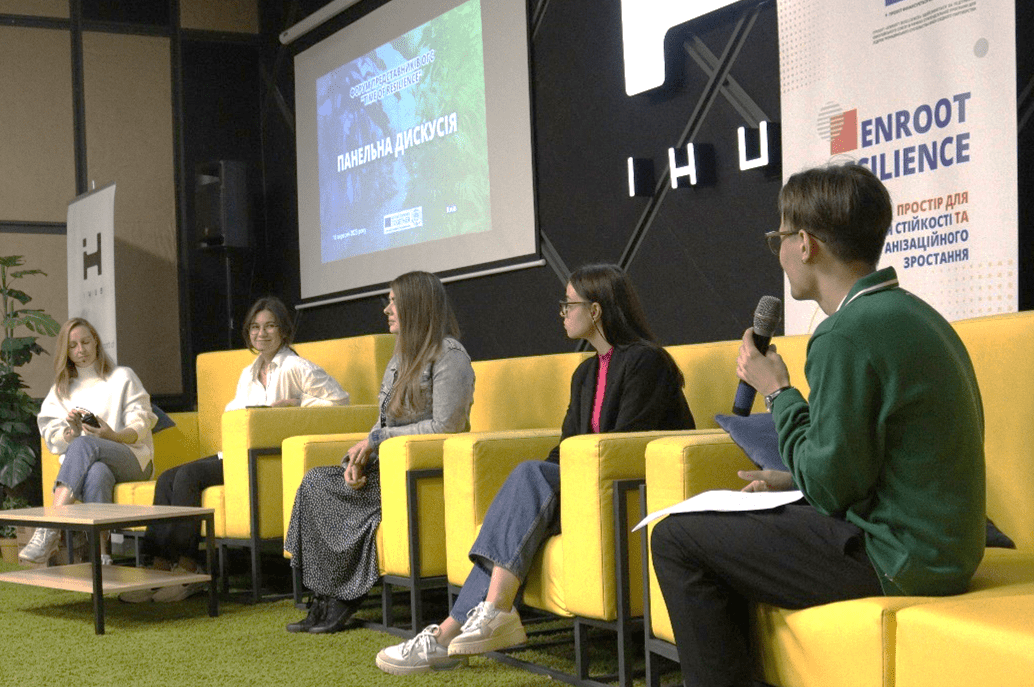
To conclude his fellowship project Rostyslav hosted a ‘Time for Resilience’ forum, with a mixture of more than 100 offline and online participants.  The day-long event involved inputs of lots of different practitioners from civil society, including from other civil society fellows, such as Hanna Nishnindze who delivered a session on Fundraising, and was well-supported with participation from the management of the National Youth Council and local office for Erasmus+ coordination.  The feedback from the forum has been excellent:

Many of the young activists used it as a springboard for building new partnerships,” noted Rostyslav, “with others, since the forum, successfully taking on community leadership positions.

Taking on board the lessons learned from the fellowship, the initial ‘inspiration café’ organization has now been transformed to a CSO called ‘Education 360’ and, with Rostyslav’s and his colleagues’ increased organizational capacities, the CSO has a clear strategy and annual plans.  Rostyslav intends to continue to split his time between his formal school teaching duties and the activism managed through ‘Education 360’.

Watch a series of videos to help grassroots organisations to take their first steps in community projects (in Ukrainian only!):

1) The Art of Grant Writing: You will learn the key stages of writing a grant proposal and effective strategies to ensure a successful outcome.

2) Communications and Promotion for CSOs: You will learn how to increase the visibility of your organization through effective communication and promotion.

3) Forming partnerships: You will learn how to create strong partnerships to sustain and strengthen the organization. 

4) Scaling: You will learn how to grow your community and distribute your products or services.

5) Project Planning: You will learn the important steps and strategies that will ensure the success of your project.

6) How to prevent emotional burnout?: You will learn how to take care of your emotional health and avoid emotional burnout.

7) How to successfully fundraise?: You will learn about the most effective methods of attracting financial resources for your organization.

Country Ukraine
The scope of
Type of solution
The technology used
The budget development decisions 0

Team

Mentorship Program for Ukrainian youth “MentorUkraine”

Fellowship Summary: Mentoring programme to connect young Ukrainians (mentees) with students from unvesities abroad (mentors) to help them with personal development. Mentors help Ukrainians to apply to universities, write personal statements and CVs, support moving abroad during the war, and overcome the language barrier.

Updates coming soon!

Country Ukraine
The scope of
Type of solution
The technology used
The budget development decisions 0

Team

Innovating Education: Building Capacity for Advocacy, Policy Analysis, and Cross-Movement Cooperation in Marginalized Communities

Fellowship Summary: Based on good practices from Georgia, build capacity in advocacy and policy analysis for a cohort of civil society activists and youth from marginalized communities in Ukraine to shift from single-issue activism towards coalition-building and transformative work.

Updates coming soon!

Country Ukraine
The scope of
Type of solution
The technology used
The budget development decisions 0

Team

Youth in Action: A Series of Project Management Trainings for Young People

Fellowship Summary: A series of project management trainings for 80 young people from 4 regions “Youth in action” to increase their knowledge in the field of project management and public sector management.

Updates coming soon!


Country Ukraine
The scope of
Type of solution
The technology used
The budget development decisions 0

Team

Development of Chatbots Construction Platform for Local Communities

Fellowship Summary: Create and launch a digital solution that facilitates citizens in Ukraine to report and/or complain to local authorities in a formally documented manner.

Updates coming soon!

Country Ukraine
The scope of
Type of solution
The technology used
The budget development decisions 0

Team

Restoration of de-occupied territories, with the interaction of ecologists, artists, urbanists, journalists and representatives of local communities

Fellowship Summary: Creating and promoting recommendations for restoration of de-occupied territories based on real-life examples from Irpin, Chernihiv, Kherson; and in consultations with experts and stakeholders: ecologists, artists, urbanists, journalists, representatives of local communities, etc.

Myroslava project, Chronicles of Recovery, brought together an inspiring community of artists, ecologists, psychologists, urbanists, and communicators who explore how working with plants can support emotional and social recovery in times of war. The initiative emerged from the idea that interaction with nature – planting, growing, observing – can help people process trauma and reconnect with life amidst destruction.

Building on the experience of ArtPole Agency’s earlier work in de-occupied Irpin supported within our #StandWithUkraine Call in 2022, the project evolved into a collaborative network spanning de-occupied Irpin and Bucha, Kherson, Kyiv, and beyond. Experts from diverse fields came together through meetings, research trips, and joint discussions to share practices of ecological restoration and community care.

A key result of the project is the bilingual online platform Chronicles of Recovery – a living archive of stories, practical advice, and connections. It documents experiences collected during expert meetings and field visits, showcasing how communities are rebuilding not only physical spaces but also emotional resilience.

“The materials we collected aim to give something practical,” says Myroslava. “But also something that helps to pause, find like-minded people, and look at things from another perspective – something that makes it easier to move forward.”

The community formed during the Fellowship continues to grow. Its members are developing new collaborations, from eco-construction initiatives to rehabilitation projects for veterans, and contributing to international discussions on soil regeneration and biochar technology. Through Chronicles of Recovery, Myroslava’s project plants not only seeds in the ground but also seeds of healing, solidarity, and hope.

“It’s difficult to go to a de-occupied city and just document how people live there. I want to help.” Interview with Myroslava Ganyushkina in ELLE (in Ukrainian)


Country Ukraine
The scope of
Type of solution
The technology used
The budget development decisions 0

Team